<?xml version="1.0" encoding="utf-8"?><feed xmlns="http://www.w3.org/2005/Atom" ><generator uri="https://jekyllrb.com/" version="3.10.0">Jekyll</generator><link href="https://www.mithunshanbhag.com/feed.xml" rel="self" type="application/atom+xml" /><link href="https://www.mithunshanbhag.com/" rel="alternate" type="text/html" /><updated>2026-10-19T19:29:44+00:00</updated><id>https://www.mithunshanbhag.com/feed.xml</id><title type="html">Mithun Shanbhag</title><subtitle>Is anyone actually reading this?</subtitle><author><name>Mithun Shanbhag</name></author><entry><title type="html">Conquering fear</title><link href="https://www.mithunshanbhag.com/2026/08/27/conquering-fear.html" rel="alternate" type="text/html" title="Conquering fear" /><published>2026-08-27T00:00:00+00:00</published><updated>2026-08-27T00:00:00+00:00</updated><id>https://www.mithunshanbhag.com/2026/08/27/conquering-fear</id><content type="html" xml:base="https://www.mithunshanbhag.com/2026/08/27/conquering-fear.html"><![CDATA[<p><img src="../../../images/conquering-fear-comic-strip-linkedin-cover.png" alt="comic strip - linkedin cover" /></p>

<blockquote>

  <p>“Life shrinks or expands in proportion to one’s courage.” - Anais Nin</p>

  <p>“Everything you want is on the other side of fear.” - Jack Canfield</p>

</blockquote>

<h2 id="whats-in-your-cocktail">What’s in your cocktail?</h2>

<p>What we loosely term as <strong>fear</strong> is generally a cocktail that your brain blends together from multiple ingredients: anxiety, shame, guilt, humiliation, embarrassment, regret, uncertainty, helplessness, inexperience, inhibitions, unfamiliarity, vulnerability, apprehension, despair, ego, unhappiness, insecurities, laziness, inertia, reservation, misgiving, mistrust, and many more. Yes, and fear itself.</p>

<p>Sip this cocktail, and you’ll be in a perpetual state of anxiety-driven paralysis.</p>

<h2 id="no-silver-bullets">No silver bullets</h2>

<p>But know that there is no workaround; we have to take these fears head-on: we have to acknowledge them, define them, face them, and ultimately take action to conquer them.</p>

<p>Growing up as a kid, and for the early part of my adult life, my fears were mostly about embarrassing myself in front of my friends/peers/coworkers.</p>

<p>Later in life, my fears evolved too. As a business owner and organization leader, I dreaded dealing with govt officials, dealing with paperwork, talking to customers, and asking people for favours/help.</p>

<p>Note: I did say these fears were irrational 😀.</p>

<h2 id="what-worked-for-me">What worked for me</h2>

<p>I can attribute most of my personal &amp; professional growth to simply taking my fears head-on. A few things that have helped me tremendously:</p>

<h3 id="fear-setting-exercise">Fear-setting exercise</h3>

<p>Tim Ferriss’ process and framework around tackling fears has been particularly useful.</p>

<ul>
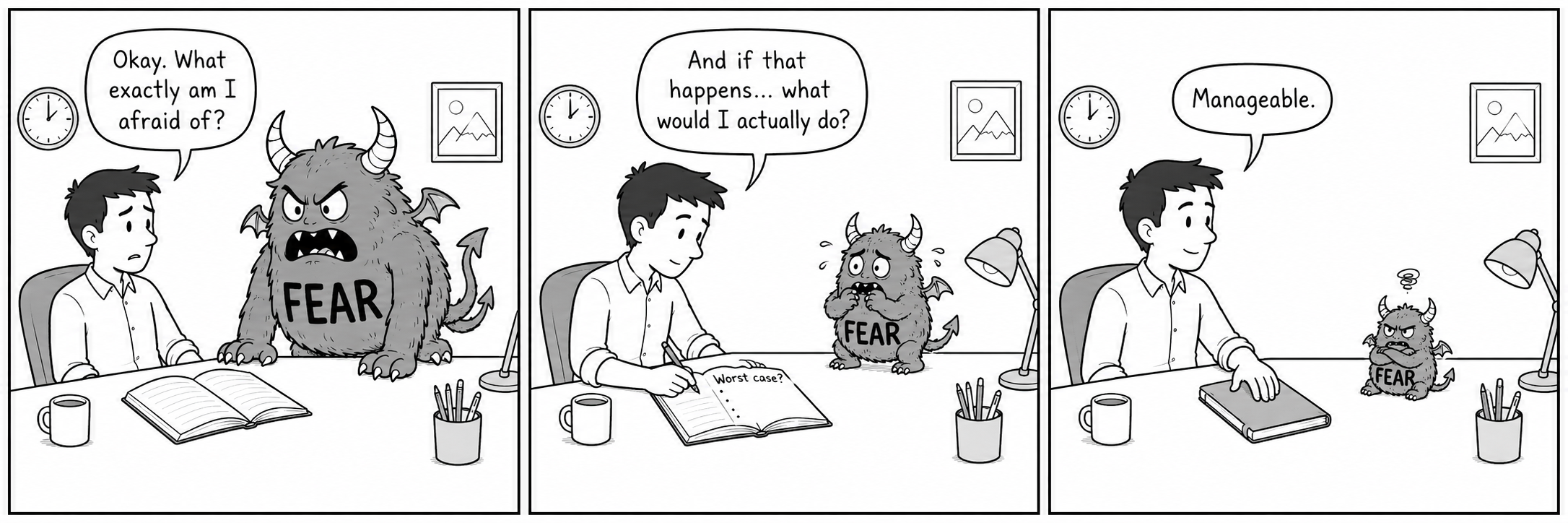
  <li>First, I acknowledge and write down my fears.</li>
  <li>Then I write down the worst-case scenarios for each fear.</li>
  <li>Then I write down what I’ll do should that worst-case scenario ever materialize.</li>
</ul>

<p>As an example, I have a (possibly irrational) paranoia about losing my phone. So I did a simple fear-setting exercise, documenting the worst-case outcomes and the steps that I can take to prevent/mitigate them (<a href="/2023/02/25/preparing-for-device-loss.html">LINK</a>).</p>

<!-- markdownlint-disable-next-line -->
<iframe width="560" height="315" src="https://www.youtube.com/embed/5J6jAC6XxAI?si=lUTh2_WQjZCMTsqx" title="YouTube video player" frameborder="0" allow="accelerometer; autoplay; clipboard-write; encrypted-media; gyroscope; picture-in-picture; web-share" referrerpolicy="strict-origin-when-cross-origin" allowfullscreen=""></iframe>

<!-- markdownlint-disable-next-line MD033 -->
<p><br /></p>

<h3 id="having-a-bias-for-action">Having a bias for action</h3>

<p>As Jeff Bezos recommends, take SOME action. ANY action. Basically, just put something into motion.</p>

<!-- markdownlint-disable-next-line -->
<iframe width="560" height="315" src="https://www.youtube.com/embed/NqVoOC2azZI?si=i38TRFFt4QpzHC2U" title="YouTube video player" frameborder="0" allow="accelerometer; autoplay; clipboard-write; encrypted-media; gyroscope; picture-in-picture; web-share" referrerpolicy="strict-origin-when-cross-origin" allowfullscreen=""></iframe>

<!-- markdownlint-disable-next-line MD033 -->
<p><br /></p>

<h3 id="understanding-whats-in-my-cocktail">Understanding what’s in my cocktail</h3>

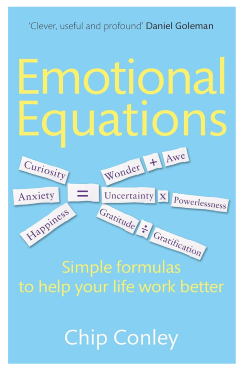
<p>I highly recommend the books by Brené Brown, Chip Conley and Marshal Goldsmith. They’ve helped me introspect on many of my own fears, insecurities, and triggers.</p>

<p><img src="../../../images/conquering-fear-book-gifts-of-imperfection.png" alt="Book: The gifts of imperfection" />
<img src="../../../images/conquering-fear-book-emotional-equations.png" alt="Book: Emotional equations" />
<img src="../../../images/conquering-fear-book-triggers.png" alt="Book: Triggers" /></p>

<p>For me, a powerful framing equation was <code class="language-plaintext highlighter-rouge">Anxiety = Powerlessness x Uncertainty</code>. Anxiety is anticipatory; it’s the feeling you get when you have no control over a situation and do not know what will happen next. Reduce it by reducing uncertainty (ask questions, gather facts, and learn more about the situation) and by reducing your powerlessness (e.g., build a support system).</p>

<h2 id="whats-real-whats-imagined">What’s real? What’s imagined?</h2>

<blockquote>

  <p>“We suffer more in imagination than in reality.” - Seneca</p>

  <p>“I am an old man and have known a great many troubles, but most of them never happened.” - Mark Twain</p>

  <p>“Fear is a gigantic demon that shrinks when you approach it.” - A parable from Indian mythology</p>

</blockquote>

<p>Fear scares us INITIALLY and IRRATIONALLY. Take solace in these two facts:</p>

<ol>
  <li>
    <p>Almost everything seems scary the first time around: Driving, swimming, public speaking, asking someone out, hiring someone, purchasing a home, yada yada. Once you take some action, you soon realize that your fears aren’t as bad as you thought they’d be.</p>
  </li>
  <li>
    <p>Most fears are just imaginary/irrational: As soon as you take some action, you’ll realize that:</p>

    <ul>
      <li>the worst-case scenario isn’t as bad as you thought it’d be. OR</li>
      <li>the probability of anything bad happening is extremely low. or</li>
      <li>should anything bad happen, you can handle/mitigate it. OR</li>
      <li>should anything bad happen, you can recover from it. OR</li>
      <li>You can prevent anything bad from happening in the first place.</li>
    </ul>
  </li>
</ol>

<p><img src="../../../images/conquering-fear-comic-strip-fear-setting.png" alt="comic strip - fear setting" /></p>

<p>The more you face your fears, the more they shrinks. Crucially, as organizational leaders, conquering your fears lowers your barrier to taking risks. More on that some other day.</p>

<p>What’s your equation with fear &amp; anxiety? How do you cope with it? How do you overcome it? Any interesting stories or anecdotes to share? Please leave a comment below.</p>]]></content><author><name>Mithun Shanbhag</name></author><summary type="html"><![CDATA[Fear often feels bigger than it is. A practical process for defining your fears, taking action, and ultimately overcoming them.]]></summary><media:thumbnail xmlns:media="http://search.yahoo.com/mrss/" url="https://www.mithunshanbhag.com/images/conquering-fear-comic-strip-linkedin-cover.png" /><media:content medium="image" url="https://www.mithunshanbhag.com/images/conquering-fear-comic-strip-linkedin-cover.png" xmlns:media="http://search.yahoo.com/mrss/" /></entry><entry><title type="html">A moonlighting tale</title><link href="https://www.mithunshanbhag.com/2026/08/21/moonlighting.html" rel="alternate" type="text/html" title="A moonlighting tale" /><published>2026-08-21T00:00:00+00:00</published><updated>2026-08-21T00:00:00+00:00</updated><id>https://www.mithunshanbhag.com/2026/08/21/moonlighting</id><content type="html" xml:base="https://www.mithunshanbhag.com/2026/08/21/moonlighting.html"><![CDATA[<p>Moonlighting: The act of secretly working a second job, without informing your first job.</p>

<p><img src="../../../images/moonlighting-comic-strip.png" alt="comic strip" /></p>

<h2 id="the-over-employment-oe-phenomenon-">The over-employment (OE) phenomenon 💼</h2>

<p>Soon after the Covid19 pandemic, when remote work became the new norm, the <a href="https://www.reddit.com/r/overemployed/">/r/overemployed</a> subreddit exploded in popularity, seemingly overnight. People were posting crazy, outlandish stories of:</p>

<ol>
  <li>Securing multiple, simultaneous full-time jobs (all remote)</li>
  <li>Doing the bare minimum at each</li>
  <li>Collecting simultaneous paychecks</li>
  <li>And getting away with it for months (and years)</li>
</ol>

<p>Peak insanity! This was fast becoming a worldwide trend in the information-work and knowledge-work sectors; the only necessary condition being that the jobs had to be remote.</p>

<p>The hilarious stories on that subreddit were a constant source of amusement to me.</p>

<p>Until.</p>

<h2 id="someone-actually-pulled-this-off-in-my-organization-">Someone actually pulled this off in my organization 😮</h2>

<p>Circa early 2022, I was serving as a fractional CTO for an mid-stage startup. Like everyone else at that time, we had transitioned into a fully-remote, fully-distributed workforce. We had just hired a new remote employee from a different city: an industry hire, senior software developer.</p>

<p>I was in the remote interview loop, and was pretty impressed with the candidate: he had aced the coding interviews, was technically sound, was easy going, and a seemed like a good culture fit. The overall consensus was a strong “hire”. Then the HR department did their standard background verification. No red flags were uncovered. The references checked out too. We rolled out the offer letter, and the candidate accepted and joined us.</p>

<ul>
  <li>
    <p><em><strong>“He looks super-promising”</strong></em>. Off to a great start! The employee’s engineer manager all enthusiastic!</p>
  </li>
  <li>
    <p><em><strong>“He’s doing all right”</strong></em>. Two months went by, and the manager’s enthusiasm had waned a bit.</p>
  </li>
  <li>
    <p><em><strong>“He’s still acclimatizing to our engineering processes and tech stack”</strong></em>. Two more months went by and there were mentions of performance/delivery gaps. But the manager was still gung-ho about handling this situation, and giving the employee a second (and third) chance.</p>
  </li>
</ul>

<p>Then, one fine day, someone from payroll flagged discrepancies in this remote employee’s EPFO (Employees Provident Fund) records. Apparently, the employee was also simultaneously working full-time for three other companies (side note: I’m hazy on the exact details now, but seemingly multiple companies were simultaneously linked to the employee’s EPFO UAN).</p>

<p>After this, I asked the HR department to intervene: they started a formal investigation, collected evidence and eventually terminated the employee. A legal notice had to be dispatched to recover the company’s equipment (laptop, monitors, etc). And till date, I have no idea whether the HR department actually notified the other three companies where this person was simultaneously employed. Perhaps he’s still working for all of them! 😂</p>

<p>I’ll fully acknowledge that we discovered this moonlighting situation purely by accident. What if there was no smoking gun i.e. EPFO records, which are only applicable to full-time employees in India? Had the employee been from another country, or had been working remotely for another non-Indian company, or had been working for other companies in the capacity of a contractor, consultant, freelancer, etc., we would have never known.</p>

<h2 id="a-minefield-of-red-flags-and-somehow-we-missed-them-all-">A minefield of red flags and somehow we missed them all 🚩🚩🚩</h2>

<p>The employee’s moonlighting had gone on for about five months before we discovered it. Reflecting back, there were some obvious tell-tale signs that something was amiss with this employee:</p>

<ol>
  <li>
    <p><strong>Bare minimum effort</strong>: Not taking ownership of their work, not taking the lead on anything. No proactivity. But just doing enough to not get fired.</p>
  </li>
  <li>
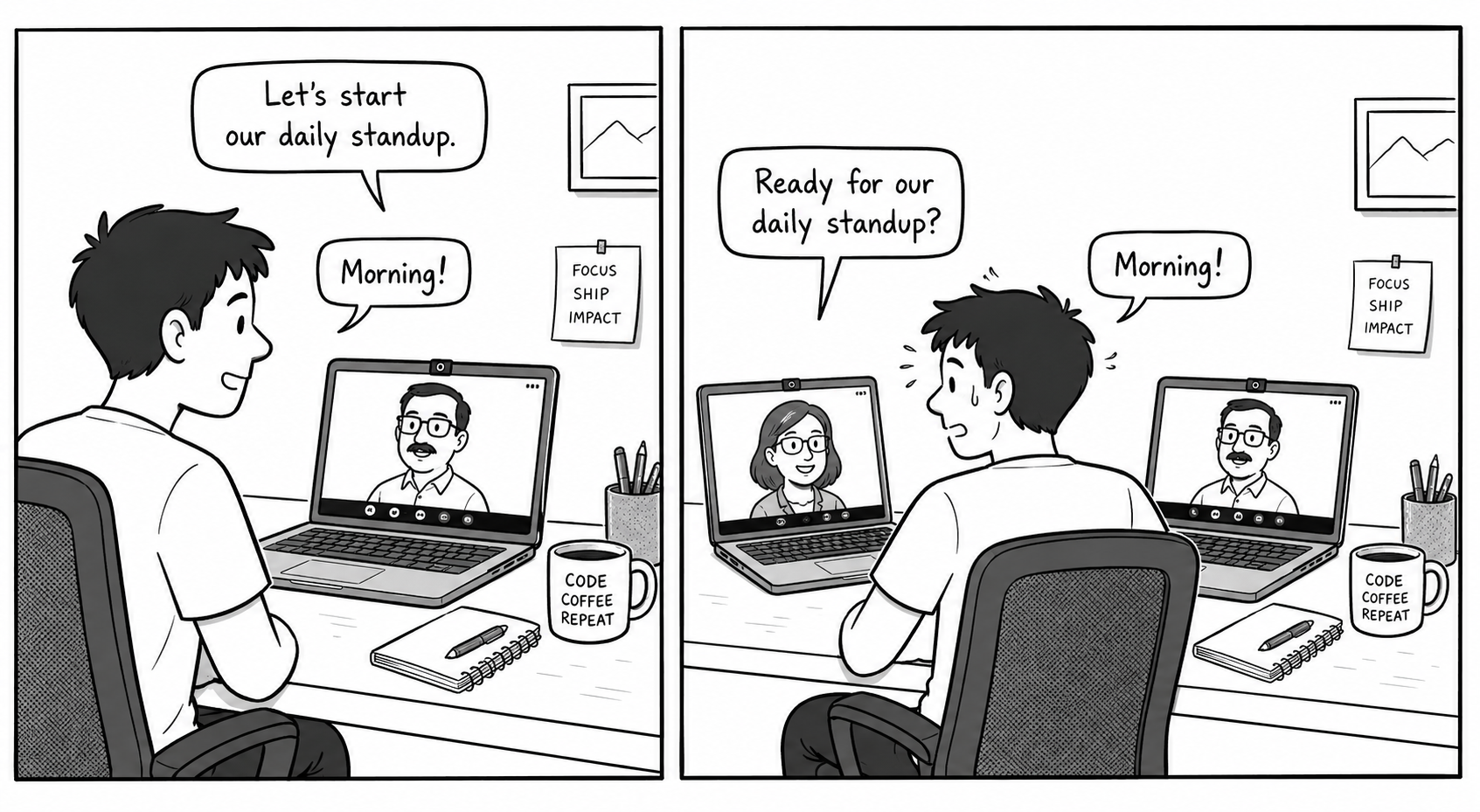
    <p><strong>Frequent absenteeism</strong>: Often skipping daily standup + other team meetings + 1:1s, not responding to emails or slack messages in a timely manner, sometimes refusing to come on camera in video calls.</p>
  </li>
  <li>
    <p><strong>Missed deadlines</strong>: It became a running joke that you had to add “+3 weeks” to any task this employee was assigned to.</p>
  </li>
</ol>

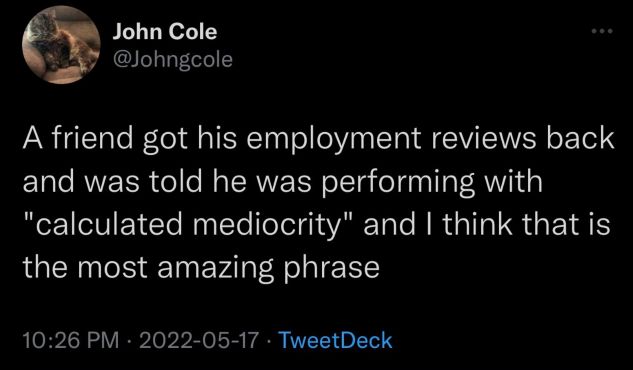
<p>Side note: The terms “calculated mediocrity”, “deliberate mediocrity”, “rehearsed mediocrity” are most often used to describe this kind of work ethic.</p>

<p><img src="../../../images/moonlighting-calculated-mediocrity.jpg" alt="calculated mediocrity" /></p>

<!-- markdownlint-disable-next-line MD033 -->
<p><br /></p>

<h2 id="what-were-my-blind-spots-️">What were my blind spots? 🕵️</h2>

<p>So, how did we miss all this? Retrospectively, I think there were a few issues with how our org functioned:</p>

<p><strong>Too much trust and naivety</strong>: We kept giving the employee the benefit of the doubt. We did a WHOLE LOT OF MENTAL GYMNASTICS to convince ourselves that the employee was not at fault here, and this was inherently fixable. Perhaps they were just distracted / lazy / unmotivated, and all they needed was little nudge. Perhaps they had a personal / family / medical situation, and all they needed was some time to sort it out. Maybe they’re just getting to grips with ReactJS, so let’s enroll them in a Pluralsight course! 😂</p>

<p>We kept deluding ourselves, and just didn’t trust our gut. If mental gymnastics and delusion were an Olympic sport, we were gold medals winners!</p>

<p><strong>Empire building</strong>: The employee’s own manager was a tad busy with empire building, and was very reluctant to let anyone go. To them, it was important to keep the headcount numbers up for budgetary reasons. To the extent that they simply glossed over the employee’s obvious performance issues.</p>

<p>This is somewhat my fault. I helped create this misaligned incentives structure in my org.</p>

<p><img src="../../../images/moonlighting-bicycle-fall.png" alt="bicycle fall" /></p>

<h2 id="the-new-fertile-grounds-for-moonlighting-">The new fertile grounds for moonlighting 🌱</h2>

<p>Ok. It’s 2026. Now what?</p>

<p>With agentic AI, it’s become easier than ever to moonlight. A $20 ChatGPT subscription for content writing or a $200 Claude / Codex agent for software development, a HeyGen/ElevenLabs subscription for media creation are all the tools needed one needs.</p>

<p>All the necessary preconditions are now in place: remote work, agentic AI, and a manager’s dwindling attention span.</p>

<p>It’s rampant now. People are moonlighting in plain sight, and employers have still not caught on!</p>

<p>Have you encountered any moonlighting in your org? Any interesting stories or anecdotes to share? Please leave a comment below.</p>]]></content><author><name>Mithun Shanbhag</name></author><summary type="html"><![CDATA[The rise of agentic AI and remote work have created new fertile grounds for employee moonlighting. As an organization leader, are you paying attention?]]></summary><media:thumbnail xmlns:media="http://search.yahoo.com/mrss/" url="https://www.mithunshanbhag.com/images/moonlighting-comic-strip.png" /><media:content medium="image" url="https://www.mithunshanbhag.com/images/moonlighting-comic-strip.png" xmlns:media="http://search.yahoo.com/mrss/" /></entry><entry><title type="html">Our noise footprint</title><link href="https://www.mithunshanbhag.com/2026/08/14/our-noise-footprint.html" rel="alternate" type="text/html" title="Our noise footprint" /><published>2026-08-14T00:00:00+00:00</published><updated>2026-08-14T00:00:00+00:00</updated><id>https://www.mithunshanbhag.com/2026/08/14/our-noise-footprint</id><content type="html" xml:base="https://www.mithunshanbhag.com/2026/08/14/our-noise-footprint.html"><![CDATA[<p><img src="../../../images/noise-comic-strip.png" alt="comic strip" /></p>

<h2 id="public-spaces-in-india-are-noisy">Public spaces in India are noisy</h2>

<p>First-time visitors to India are often overwhelmed by the constantly high noise levels: vehicles honking, music blaring, construction work, loud conversations, aside from the general hustle and bustle of the streets.</p>

<p>Travel in a train or a bus. Go to a mall, a park, or a restaurant. In public spaces, everyone’s speakerphone is on. Metaphorically, but also very literally. No one uses headphones. It’s a cacophonic soup of multiple, simultaneous phone conversations, bollywood music, youtube videos, and instagram reels blaring away endlessly.</p>

<p>Noise is omnipresent here, and often does not abate until very, very late into the night. Anti-noise ordinances and regulations are practically non-existent here.</p>

<h2 id="but-our-offices-are-less-noisy-right">But our offices are less noisy, right?</h2>

<p>Ummm, not really. Constant phone calls. Zoom meetings. Music playing in the background. Device and app notifications going off like fireworks. Loud hallway conversations.</p>

<p>For the last 8 years, I’ve worked out of a cabin in a co-working space. In my time here, I’ve seen hundreds of companies come and go. The one constant has been their high noise footprint. In many startups, these noisy environments are fomented by the founders themselves, who feel compelled to create this exuberant high-energy hustle-culture hubris. A founder once told me that a silent workspace feels “dead” to them, and that they feel compelled to inject some “energy”.</p>

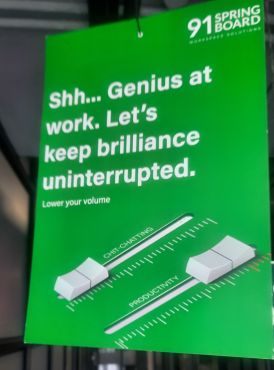
<p>Once in a blue moon, someone from their HR department will send out a reminder (or post a super-cringy flyer) to keep noise levels down. Almost always lip service, never backed by any punitive action.</p>

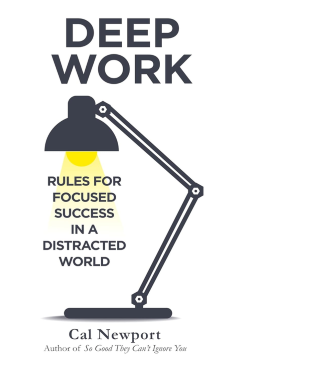
<p>Sometimes someone in the org will hand out copies of Cal Newport’s Deep Work. The ironic thing being that everyone is so attention-deficit and hyper-distracted these days. We’re just unable to read a book from cover to cover these days. Deep work? What deep work? By default, there is no possibility of deep work here. Unless you change the environment. More on that a bit later.</p>

<p><img src="../../../images/noise-cringy-flyers.png" alt="cringy flyer" />
<img src="../../../images/noise-deep-work-book.png" alt="deep work book" /></p>

<h2 id="why-oh-why-does-this-happen">Why oh why does this happen?</h2>

<p>Over on social media, people often debate what causes this… a lack of workplace etiquette? Or a lack of civic sense? Personally, I think it’s neither.</p>

<p>I’m convinced that the singular root cause is the lack of awareness. If one is not aware of the rules/etiquettes, then can they be expected to follow them? Can they be blamed for breaking them? Our society has normalized noise to such an extent that people have become desensitized to it and don’t even know that quiet workspaces can be a possibility.</p>

<p>Lack of infrastructure planning also plays a part. Floor plans for office buildings do not often include focus rooms or phone rooms (for cost reasons).</p>

<h2 id="dealing-with-noise">Dealing with noise</h2>

<p>Attempting to bring about larger cultural, societal change and awareness on this topic might seem futile. It may take decades (or centuries). We’ll all be long dead by then.</p>

<p>But let’s not be cynical! I encourage all of you to be good role models and lead by example. At least in your office. Your coworkers may not immediately follow suit, but they’ll slowly notice, then they’ll slowly emulate. Be hopeful and patient. It’s not a lost cause; it’s just a slow compounding thing.</p>

<p>In the interim, the other most important thing is acceptance. Accept and embrace the fact that noise is inevitable. You can’t fight it. You can’t change it anytime soon. Build your tolerance, adapt, and slowly learn to live with it.</p>

<p>Next, get a good pair of noise-cancelling headphones. It won’t cut out the noise entirely, but will bring it down to tolerable levels. What personally worked for me:</p>

<ol>
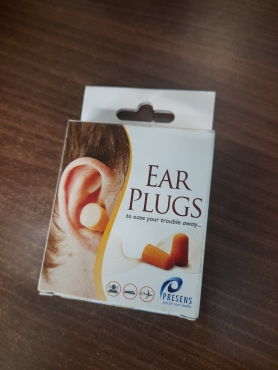
  <li>Foam earplugs. AND</li>
  <li>Ear muffs (like the ones used in shooting ranges or construction sites). Dorky but highly effective!</li>
</ol>

<p><img src="../../../images/noise-foam-ear-plugs.jpg" alt="foam ear plugs" />
<img src="../../../images/noise-ear-muffs.png" alt="ear muffs" /></p>

<h2 id="food-for-thought">Food for thought</h2>

<p>I propose the concept of noise footprint. Similar to carbon footprint, but for noise. How much noise do you make in a day? A metric which could be applied to individuals, organizations, and societies. Create a world index! 😄</p>

<p>Also, remember those radar speed signs that warn you if you’re going too fast? In a similar vein, we need to build something that beeps when the decibel level in the office gets too high.</p>

<p><img src="../../../images/noise-radar-speed-sign.png" alt="radar speed sign" /></p>

<p>BTW - noise, distractions, and interruptions are all different things (but often correlated). More on that in a future post.</p>

<p>What are your thoughts on noise levels in offices? How do you deal with it? Any interesting stories or anecdotes? Please leave a comment below.</p>]]></content><author><name>Mithun Shanbhag</name></author><summary type="html"><![CDATA[Public spaces and offices in India are often relentlessly noisy. Why it happens, how it affects deep work, and the coping strategies that actually help.]]></summary><media:thumbnail xmlns:media="http://search.yahoo.com/mrss/" url="https://www.mithunshanbhag.com/images/noise-comic-strip.png" /><media:content medium="image" url="https://www.mithunshanbhag.com/images/noise-comic-strip.png" xmlns:media="http://search.yahoo.com/mrss/" /></entry><entry><title type="html">Concept 1 - Journal to comic</title><link href="https://www.mithunshanbhag.com/2026/07/09/spc-concept1.html" rel="alternate" type="text/html" title="Concept 1 - Journal to comic" /><published>2026-07-09T00:00:00+00:00</published><updated>2026-07-09T00:00:00+00:00</updated><id>https://www.mithunshanbhag.com/2026/07/09/spc-concept1</id><content type="html" xml:base="https://www.mithunshanbhag.com/2026/07/09/spc-concept1.html"><![CDATA[<p>Turn your journal into daily comic strips.</p>

<h2 id="step-1-upload-selfies">Step 1: Upload selfies</h2>

<p><img src="../../../images/comic-original.png" alt="original picture" /></p>

<h2 id="step-2-likeness--avatars-generated">Step 2: Likeness / avatars generated</h2>

<p>The app will automatically generate avatars based on your selfies. You can choose from a variety of styles and expressions to represent yourself in the comic strips.</p>

<p><img src="../../../images/comic-avatar.png" alt="generated avatars" /></p>

<h2 id="step-3-get-daily-personalized-comic-strips">Step 3: Get daily personalized comic strips</h2>

<p>As you update your daily journal, the app will generate daily comic strips based on your entries.</p>

<p>Each strip will reflect your thoughts, anecdotes, interactions, observations, and experiences in a fun and engaging way.</p>

<p><strong>Sample daily strip 1</strong>
<img src="../../../images/comic-strip1.png" alt="comic strip 1" /></p>

<p><strong>Sample daily strip 2</strong>
<img src="../../../images/comic-strip2.png" alt="comic strip 2" /></p>

<p><strong>Sample daily strip 3</strong>
<img src="../../../images/comic-strip3.png" alt="comic strip 3" /></p>]]></content><author><name>Mithun Shanbhag</name></author><summary type="html"><![CDATA[Turn your journal into daily comic strips.]]></summary><media:thumbnail xmlns:media="http://search.yahoo.com/mrss/" url="https://www.mithunshanbhag.com/images/logo_400_400.jpg" /><media:content medium="image" url="https://www.mithunshanbhag.com/images/logo_400_400.jpg" xmlns:media="http://search.yahoo.com/mrss/" /></entry><entry><title type="html">Concept 2 - Workplace comic strips</title><link href="https://www.mithunshanbhag.com/2026/07/09/spc-concept2.html" rel="alternate" type="text/html" title="Concept 2 - Workplace comic strips" /><published>2026-07-09T00:00:00+00:00</published><updated>2026-07-09T00:00:00+00:00</updated><id>https://www.mithunshanbhag.com/2026/07/09/spc-concept2</id><content type="html" xml:base="https://www.mithunshanbhag.com/2026/07/09/spc-concept2.html"><![CDATA[<p>Use daily bite-sized comic strips to create cohesive teams. Drive internal workplace comms in an engaging way.</p>

<h2 id="app-form">App form</h2>

<ul>
  <li>Primary interaction will be via Slack bot (or Microsoft Teams bot, or Google Workspace bot).</li>
  <li>Web app for configuration and analytics.</li>
</ul>

<h2 id="step-1-identify-key-workplace-objectives">Step 1: Identify key workplace objectives</h2>

<p>Choose what you want to emphasize and reinforce in your workplace. Some examples:</p>

<ul>
  <li>Employee morale</li>
  <li>Employee wellness</li>
  <li>Workplace etiquettes</li>
  <li>Soft skills</li>
  <li>Policy awareness</li>
  <li>Safety, security awareness</li>
  <li>Team building</li>
  <li>Company values, mission, vision</li>
  <li>Employee recognition</li>
  <li>Deadline reminders</li>
</ul>

<h2 id="step-2-comic-strips-and-messaging-generated">Step 2: Comic strips and messaging generated</h2>

<p>The app will automatically generate comic strips based on the identified objectives.</p>

<p>You can personalize those strips with your company’s branding (logos, mascots, color palette, etc) and choose from a variety of styles and expressions to represent your team in the comic strips.</p>

<h2 id="step-3-internal-comms-via-daily-personalized-comic-strips">Step 3: Internal comms via daily personalized comic strips</h2>

<p><strong>Example: Security awareness</strong>
<img src="../../../images/workplace1.png" alt="comic strip 1" /></p>

<p><strong>Example: Employee wellness</strong>
<img src="../../../images/workplace2.png" alt="comic strip 2" /></p>

<p><strong>Example: Workplace etiquettes</strong>
<img src="../../../images/workplace3.png" alt="comic strip 3" /></p>]]></content><author><name>Mithun Shanbhag</name></author><summary type="html"><![CDATA[Use daily bite-sized comic strips to create cohesive teams. Drive internal workplace comms in an engaging way.]]></summary><media:thumbnail xmlns:media="http://search.yahoo.com/mrss/" url="https://www.mithunshanbhag.com/images/logo_400_400.jpg" /><media:content medium="image" url="https://www.mithunshanbhag.com/images/logo_400_400.jpg" xmlns:media="http://search.yahoo.com/mrss/" /></entry><entry><title type="html">My local dev machine setup</title><link href="https://www.mithunshanbhag.com/2025/02/28/my-dev-setup.html" rel="alternate" type="text/html" title="My local dev machine setup" /><published>2025-02-28T00:00:00+00:00</published><updated>2025-02-28T00:00:00+00:00</updated><id>https://www.mithunshanbhag.com/2025/02/28/my-dev-setup</id><content type="html" xml:base="https://www.mithunshanbhag.com/2025/02/28/my-dev-setup.html"><![CDATA[<p>Recently, I had to replace my PC’s old SSD, which meant I had to reinstall all my dev tools and utilities. I thought I’d document my setup here for posterity. This is a living document, and I’ll keep updating it as my setup evolves.</p>

<p>My primary development environment is WSL (Linux on Windows), and macOS occasionally. Developing with .NET on Azure is where I’m most comfortable at, but I also dabble heavily in Angular / TypeScript, and other frameworks &amp; clouds occasionally.</p>

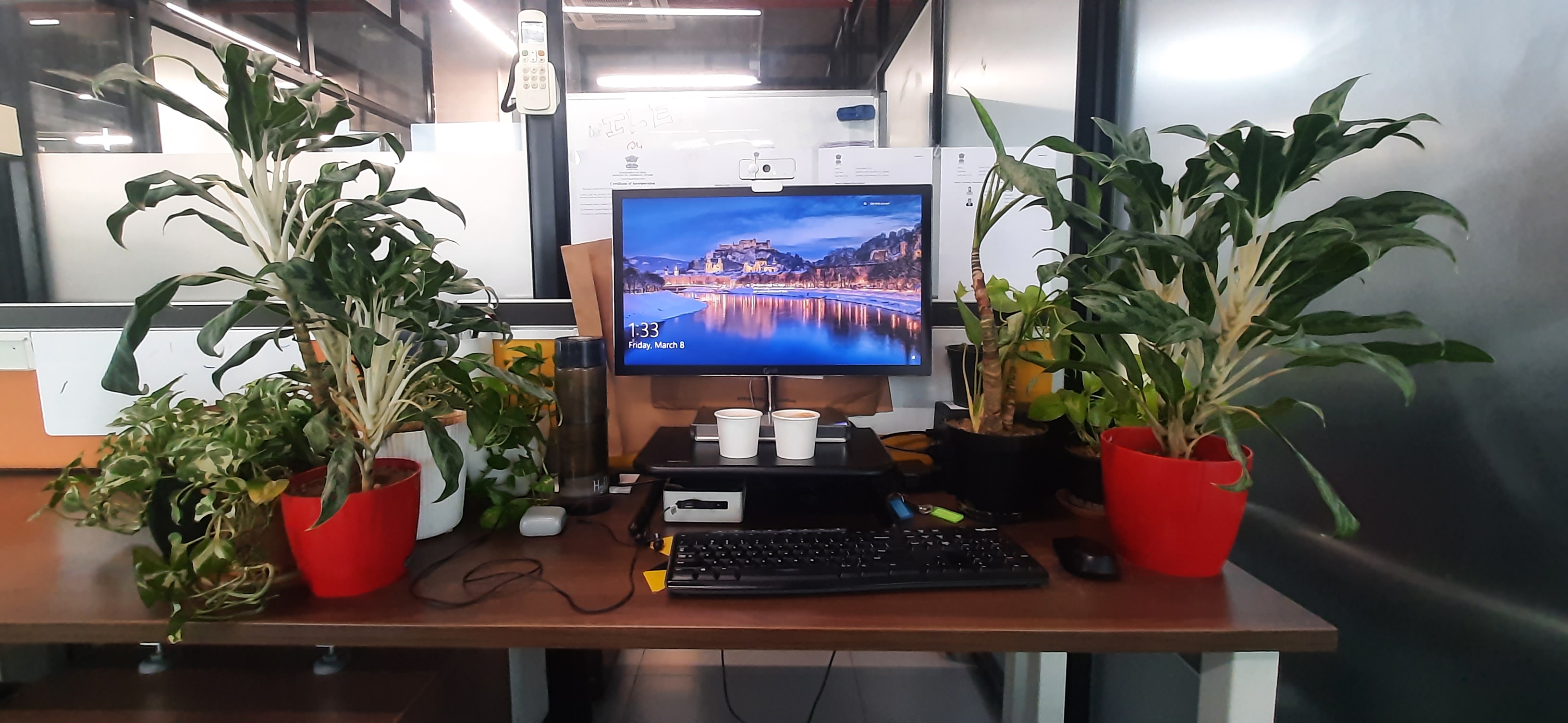
<p><img src="../../../images/my-pc.jpg" alt="my pc" /></p>

<h2 id="ides-code-editors-extensionsplugins">IDEs, code editors, extensions/plugins</h2>

<ul>
  <li><a href="https://www.linqpad.net/">LinqPad</a>: Quick scratchpad app to test out your .NET code snippets. Do buy the license for autocompletion. Worth every penny!</li>
  <li><a href="https://visualstudio.microsoft.com/">Visual Studio</a> with <a href="https://www.jetbrains.com/resharper/">ReSharper</a> extension.
    <ul>
      <li>I also use the <a href="https://www.jetbrains.com/help/resharper/ReSharper_Command_Line_Tools.html">ReSharper CLI tools</a>, which include nifty utilities for code inspection and code cleanup.</li>
    </ul>
  </li>
  <li><a href="https://code.visualstudio.com/">Visual Studio Code</a>
    <ul>
      <li>I use <a href="https://code.visualstudio.com/docs/editor/settings-sync">Settings Sync</a> to ensure that my vscode settings &amp; extensions are synced across all my machines.</li>
      <li>I have some 50+ extensions installed (<a href="https://gist.github.com/mithunshanbhag/ad7c4d02856eac62244ccaf37d29ea2c">see full list here</a>).</li>
    </ul>
  </li>
</ul>

<blockquote>
  <p>I’ve been meaning to play with <a href="https://www.jetbrains.com/rider/">Rider</a> for a while now. I’ve heard good things about it, especially for .NET Core development. But I’m so set in my ways with Visual Studio + ReSharper (especially the key bindings) that I haven’t made the switch yet.</p>
</blockquote>

<h2 id="ai-development-tools">AI development tools</h2>

<ul>
  <li><a href="https://developers.openai.com/codex/app">Codex/ChatGPT Desktop App</a>: My daily driver for AI-assisted coding. This app has made “chat with your codebase” seamless. I’ve configured tons of plugins and daily scheduled tasks in it.</li>
  <li><a href="https://github.com/features/copilot/cli">Github Copilot CLI</a>: I use it very infrequently now (mostly because I still have an active annual subscription). Allows me to choose from multiple models.</li>
  <li><a href="https://developers.openai.com/codex/cli">Codex CLI</a>: Command-line interface for Codex.</li>
  <li><a href="https://notebooklm.google.com/">NotebookLM</a>: Chat and converse with your documents &amp; other sources of information. Love the “interactive podcast” feature.</li>
</ul>

<blockquote>
  <p>For now, my go-to models are <code class="language-plaintext highlighter-rouge">5.6 Sol</code> and <code class="language-plaintext highlighter-rouge">5.6 Terra</code> (depending on the complexity of the tasks). Things are very rapidly evolving and new models, tools, IDEs, etc. are popping up all the time. I’m sure I’ll be adding more to this list in the near future.</p>
</blockquote>

<h2 id="core-utilities-terminal-scripting">Core utilities, terminal, scripting</h2>

<ul>
  <li><a href="https://docs.microsoft.com/en-us/windows/wsl/">WSL</a>: For running Linux on Windows.</li>
  <li><a href="https://github.com/microsoft/terminal">Windows Terminal</a>: A new, modern, feature-rich terminal application for command-line users.</li>
  <li><a href="https://learn.microsoft.com/en-us/windows/package-manager/winget/">Winget</a>: Basically “apt-get” for Windows.</li>
  <li><a href="https://learn.microsoft.com/en-us/powershell/scripting/install/installing-powershell?view=powershell-7.5">PowerShell</a>: For ad-hoc scripting tasks.</li>
  <li><a href="https://ohmyposh.dev/">Oh My Posh</a>: For customizing your PowerShell prompt. I use the <a href="https://ohmyposh.dev/docs/themes#agnoster">agnoster theme</a> as-is.</li>
  <li><a href="https://github.com/microsoft/cascadia-code">Cascadia Code (font)</a>: An awesome monospaced font; I use the nerd-font version in my terminal and IDEs.</li>
  <li><a href="https://git-scm.com/">Git</a>: For version control.
    <ul>
      <li>Also enable <a href="https://github.com/GitCredentialManager/git-credential-manager#readme">Git Credential Manager</a> for better authentication management.</li>
      <li>And <a href="https://git-lfs.github.com/">Git LFS</a> for managing large files.</li>
      <li>And long path support: <code class="language-plaintext highlighter-rouge">git config --global core.longpaths true</code> (also do this in the <a href="https://learn.microsoft.com/en-us/windows/win32/fileio/maximum-file-path-limitation?tabs=powershell#enable-long-paths-in-windows-10-version-1607-and-later">Windows OS</a>)</li>
    </ul>
  </li>
  <li><a href="https://cli.github.com/">GitHub CLI</a>: For managing GitHub repositories.</li>
  <li><a href="https://support.microsoft.com/en-us/windows/using-the-clipboard-30375039-ce71-9fe4-5b30-21b7aab6b13f">Clipboard History</a>: For copy/pasting multiple items.</li>
  <li><a href="https://github.com/burntsushi/ripgrep">RipGrep</a>: A faster grep variant that respects .gitignore files.</li>
</ul>

<h2 id="browser-and-web-stuff">Browser and web stuff</h2>

<ul>
  <li><a href="https://www.mozilla.org/en-US/firefox/new/">Firefox</a>: My primary browser. I use the following extensions:
    <ul>
      <li><a href="https://addons.mozilla.org/en-US/firefox/addon/multi-account-containers/">Multi-account containers</a>: For managing multiple identities.</li>
      <li><a href="https://addons.mozilla.org/en-US/firefox/addon/ublock-origin/">uBlock Origin</a>: For blocking ads.</li>
      <li><a href="https://addons.mozilla.org/en-US/firefox/addon/blocksite/">Block site</a>: For blocking distracting websites.</li>
      <li><a href="https://addons.mozilla.org/en-US/firefox/addon/darkreader/">Dark Reader</a>: For dark mode.</li>
      <li><a href="https://addons.mozilla.org/en-US/firefox/addon/grammarly-1/">Grammarly</a>: For grammar checking.</li>
    </ul>
  </li>
  <li><a href="https://www.telerik.com/fiddler/fiddler-classic">Fiddler Classic</a>: For debugging web traffic.</li>
</ul>

<blockquote>
  <p>I’ve been meaning to try out <a href="https://www.telerik.com/fiddler/fiddler-everywhere">Fiddler Everywhere</a>, but haven’t had the chance yet.</p>
</blockquote>

<h2 id="cloud-containers">Cloud, containers</h2>

<blockquote>
  <p>I’m pretty much all-in on Azure. I’ve dabbled with AWS and GCP, but Azure is where I feel most comfortable.</p>
</blockquote>

<ul>
  <li><a href="https://www.docker.com/products/docker-desktop">Docker Desktop</a>: For running containers locally (internally it uses WSL partitions).</li>
  <li><a href="https://docs.microsoft.com/en-us/cli/azure/">Azure CLI</a>: For managing Azure resources.</li>
  <li><a href="https://docs.microsoft.com/en-us/powershell/azure/overview">Azure PowerShell</a>: For managing Azure resources.</li>
  <li><a href="https://github.com/Azure/Azurite">Azurite</a>: For emulating Azure Storage services locally.</li>
  <li><a href="https://azure.microsoft.com/en-us/features/storage-explorer/">Azure Storage Explorer</a>: For managing Azure storage accounts (including local storage emulator).</li>
  <li><a href="https://docs.microsoft.com/en-us/azure/cosmos-db/local-emulator">Azure Cosmos DB Emulator</a>: For running Cosmos DB locally.</li>
</ul>

<h2 id="misc-tools-utilities">Misc tools, utilities</h2>

<ul>
  <li><a href="https://devtoys.app/">DevToys</a>: Collection of oddball developer utils (e.g. Base64 encoder/decoder, JWT decoder, regex tester, JSON &lt;-&gt; YAML converter, etc).</li>
  <li><a href="https://docs.microsoft.com/en-us/sysinternals/">Sysinternals Suite</a>: Tons of useful tools, including <a href="https://learn.microsoft.com/en-us/sysinternals/downloads/zoomit">ZoomIt</a>.</li>
  <li><a href="https://windirstat.net/">WinDirStat</a>: For visualizing disk usage.</li>
  <li><a href="https://github.com/microsoft/PowerToys">Microsoft PowerToys</a>: A set of Windows utilities to enhance productivity. I mostly use fancy zones and the color picker.</li>
  <li><a href="https://handy.computer/">Handy</a>: Voice to text transcriber. This is a great alternative to Windows’ built-in <code class="language-plaintext highlighter-rouge">WIN+H</code> dictation tool.</li>
  <li><a href="https://winmerge.org/">WinMerge</a>: Useful for diffing directories and their nested contents.</li>
  <li><a href="https://1password.com/">1Password</a>: For managing passwords &amp; keys.</li>
  <li><a href="https://one.one.one.one/">CloudFlare WARP</a>: DNS resolver and VPN service.</li>
  <li><a href="https://tailscale.com/">TailScale</a>: Secure VPN between my devices.</li>
  <li><a href="https://sqlitebrowser.org/">DB Browser for SQLite</a>: A nice GUI for SQLite DB management, queries.</li>
</ul>

<h2 id="misc-services">Misc services</h2>

<ul>
  <li><a href="https://trello.com/">Trello</a>: For managing tasks.</li>
  <li><a href="https://todo.microsoft.com/">Microsoft Todo</a>: Also for managing tasks.</li>
  <li><a href="https://www.microsoft.com/en-us/microsoft-365">Microsoft 365</a>: For office apps, but mostly for OneNote and OneDrive.</li>
</ul>

<h2 id="frameworks-libraries-sdks">Frameworks, libraries, SDKs</h2>

<ul>
  <li><a href="https://docs.microsoft.com/en-us/dotnet/core/tools/">.NET</a>: SDK, runtime and CLI for managing .NET core projects.</li>
  <li><a href="https://nodejs.org/en/">NodeJS</a>: For some server-side development, managing NPM packages.</li>
  <li><a href="https://www.typescriptlang.org/">TypeScript</a>: Mostly for building Angular apps.</li>
  <li><a href="https://angular.dev/installation">Angular</a>: For building SPAs / web apps.</li>
  <li><a href="https://aspire.dev/">Aspire</a>: Orchestrate microservices in your local dev environment.</li>
</ul>

<p>That’s it folks! Know of any awesome tool that I should be using? Would love to hear from you, <a href="https://twitter.com/MithunShanbhag">send me a tweet</a>.</p>]]></content><author><name>Mithun Shanbhag</name></author><summary type="html"><![CDATA[Recently, I had to replace my PC’s old SSD, which meant I had to reinstall all my dev tools and utilities. I thought I’d document my setup here for posterity. This is a living document, and I’ll keep updating it as my setup evolves.]]></summary><media:thumbnail xmlns:media="http://search.yahoo.com/mrss/" url="https://www.mithunshanbhag.com/images/logo_400_400.jpg" /><media:content medium="image" url="https://www.mithunshanbhag.com/images/logo_400_400.jpg" xmlns:media="http://search.yahoo.com/mrss/" /></entry><entry><title type="html">My playbook</title><link href="https://www.mithunshanbhag.com/2023/02/28/my-playbook.html" rel="alternate" type="text/html" title="My playbook" /><published>2023-02-28T00:00:00+00:00</published><updated>2023-02-28T00:00:00+00:00</updated><id>https://www.mithunshanbhag.com/2023/02/28/my-playbook</id><content type="html" xml:base="https://www.mithunshanbhag.com/2023/02/28/my-playbook.html"><![CDATA[<p>Based on my life experiences, I’ve cobbled together this playbook that has helped me in my growth/development. This is mostly for my own reference, but I hope it helps you too (disclaimer: I make no guarantees).</p>

<p>Most of the things in this playbook aren’t my original ideas; they’re mostly things I’ve imbibed from various books, podcasts, TED talks, YouTube videos, documentaries, friends, mentors, co-workers, and what have you (I’ve tried to give credit where it’s due). But everything in this playbook has been tried, tested and proven to work <strong>for me</strong>. Again, your mileage may vary.</p>

<p>I intend for this to be a living document that I hope to update &amp; tweak every now and then.</p>

<hr />

<h2 id="systems-over-goals">Systems over goals</h2>

<blockquote>

  <p>“Systems are for people who care about winning repeatedly. Goals are for people who care about winning once.” - James Clear</p>

  <p>“Losers have goals. Winners have systems.” - Scott Adams</p>

</blockquote>

<p>In my early 30s, I was super-obsessed with hitting goals &amp; checking off bucket-list items: weight goals, marathon running goals, bench/squat/deadlift goals, countries &amp; places to visit, list of books to read, salary goals, job title goals, career goals, restaurants to try out, net worth goals, hobbies to try out, you name it!</p>

<p>I would set goals, and then I would religiously track my progress towards those goals.</p>

<p>And it would ALWAYS end with me getting frustrated!</p>

<ul>
  <li>Either because I failed to make progress towards those goals.</li>
  <li>Or because I failed to achieve those goals.</li>
  <li>But mostly because I lost track of why I had those goals in the first place.</li>
  <li>Also, if a goal was achieved, my motivation to keep going would just drop off a cliff.</li>
</ul>

<p>Goals were temporary, they simply didn’t endure.</p>

<hr />

<blockquote>

  <p>“Success doesn’t come from what you do occasionally, but from what you do consistently.” - Unknown wise person</p>

  <p>“We don’t rise to the level of our expectations, we fall to the level of our training.” - Archilochus</p>

  <p>“You do not rise to the level of your goals. You fall to the level of your systems.” - James Clear</p>

  <p>“The more you sweat in practice, the less you bleed in battle.” - Ancient proverb</p>

</blockquote>

<p><a href="https://www.amazon.in/How-Fail-Almost-Everything-Still/dp/0241003709">Scott Adams’ advice on ‘goals vs systems’</a> was an eye-opener for me. Goals are just a means to an end. They’re not the end in themselves.</p>

<p>Instead of creating goals, we need to create systems: something we execute repeatedly, over and over again. The critical word here is ‘repeatedly’; the benefits of a system compound only over a long run. There are almost no visible short-term gains, and there almost certainly will be pains in the near term.</p>

<p>For a system to endure, it needs to be consistently executed. The more predictable and boring a system is, the better. The more automated a system is, the better. We have to take will-power out of the equation (cause we only have a very finite supply of it).</p>

<p>With systems, we’re creating the guardrails that prevents our lives from falling off the cliff, or into a ditch.</p>

<blockquote>
  <p>Aside: The words ‘systems’, ‘habits’, ‘routines’, ‘practices’, ‘rituals, ‘frameworks’, ‘trainings’ etc. are all synonyms for me. I use them interchangeably.</p>
</blockquote>

<hr />

<p>I’m not going to regurgitate what Scott Adams has already said in his book, but I’ll give a few examples of systems that have worked for me:</p>

<p>Financial systems: Someday, I’ll do a deep-dive on these, but for now, I’ll just briefly mention them: diversifying income streams, regular SIP investing, creating an emergency fund, creating a succession plan (will), getting insured (health &amp; term/life), and saving on taxes.</p>

<p>Productivity systems: Our productivity is a mostly function of two things: our ability to pick the right things to do, and our ability to getting those things done fast. Once you’ve identified the right problems to tackle, then it’s all about lowering your “Mean Time To Resolution (MTTR)”, getting things done at lightning speed. Some systems that apply here: <a href="#taking-small-bets">taking small bets</a>, <a href="#letting-simplicity-win">letting simplicity win</a>, <a href="#conquering-fear">conquering fear</a>, <a href="#maximizing-energy">maximizing energy</a>, <a href="#maximizing-focus">maximizing focus</a>, <a href="#managing-your-environments">managing your environments</a>, <a href="#becoming-irreplaceable">becoming irreplaceable</a>, <a href="#being-uncomfortable">being uncomfortable</a> and <a href="#applying-leverage">applying leverage</a>.</p>

<blockquote>
  <p>Aside: Yes, some of these systems may seem a bit “out there” (for lack of a better word). I’ll expound more on them in the coming sections. Stick with me, it’s well worth it. Read on.</p>
</blockquote>

<hr />

<h2 id="conquering-fear"><a href="/2026/08/27/conquering-fear.html">Conquering fear</a></h2>

<hr />

<h2 id="letting-simplicity-win">Letting simplicity win</h2>

<blockquote>

  <p>“Simplicity is the ultimate sophistication.” - Leonardo da Vinci</p>

  <p>“Great leaders are almost always great simplifiers, who can cut through argument, debate, and doubt to offer a solution everybody can understand.” - Colin Powell</p>

  <p>“Simplicity is the keynote of all true elegance.” - Coco Chanel</p>

</blockquote>

<p>The easiest way to ensure that a “system” endures is to keep it simple. Super, brain-dead simple. The simpler it is, the easier it is to follow that system.</p>

<p>In Scott Adams’ book, he dichotomizes people as either simplifiers or as optimizers. And he argues that we’d be better off if we stick with (or at least start with) the simplest solutions. I wholeheartedly agree. As a recovering over-optimizer, I’m now firmly in the simplification camp. An optimized solution will almost certainly have a higher TCO. Yet it is not guaranteed to be better. In fact, 99% of the times, simplification will beat optimization. But unfortunately, as human beings, our evolved brains are wired to seek out optimizations/efficiencies, which makes us veer towards the complex. But we HAVE TO resist that urge and let simplicity win.</p>

<p>Why choose simple over optimal? Because choosing the simplest path makes it easier to get started, keep the momentum going, and ultimately get things done faster. Since there is less cognitive load involved, decisions get made faster. We don’t have to tap into our reserves of will-power, <a href="#maximizing-energy">energy</a> and <a href="#maximizing-focus">focus</a> either. At work, principles like lean startup, minimum viable product, and the KISS principle are all about starting simple, iterating, and then optimizing later if necessary. Similar strategies can be applied to our personal lives as well.</p>

<p>Keeping things simple is especially important when we’re working in a team/organization. The simpler the system, the easier it is to communicate (less room for misinterpretation, ambiguity), the easier it is to onboard new team members, the easier it is to iterate/maintain/improve/automate.</p>

<p>Quick tip: If we’re dealing with something that has a high probability of failure anyways, we might as well stick with whatever is simpler.</p>

<hr />

<blockquote>

  <p>“That’s been one of my mantras – focus and simplicity. Simple can be harder than complex.” - Steve Jobs</p>

</blockquote>

<p>I now religiously pursue the simplest options in my personal &amp; professional life. It may come at a higher monetary cost; I’m OK with that. It will likely be less efficient; I’m OK with that too. But simple will endure, and that’s what matters the most to me. Some examples where I have super-simplified my life via elimination, delegation or automation:</p>

<ol>
  <li>
    <p>Automation: SIP investing, bill payments, recurring subscriptions.</p>
  </li>
  <li>
    <p>Delegation: I hire a CA to handle my complex company-related paperwork (taxes, GST, compliances, etc). I could probably do these myself, but I’d rather spend my time on things that I’m good at. Also, I’d rather not risk messing up my taxes, or missing compliance-related deadlines! 😄</p>
  </li>
  <li>
    <p>Elimination: Simplicity and minimalism are recurring themes in my life. The more I simplify my life, and eliminate non-essential excesses, the more I’m able to focus on the things that really matter to me. Some baggage that I’ve jettisoned from my life:</p>
    <ul>
      <li>Caffeine, sugar, alcohol, tobacco, drugs, junk food, processed food, fast food, soda, soft drinks, anything fried, anything with refined flour. Consequently, I eliminate all the side effects &amp; health risks that come from consuming these.</li>
      <li>I’m trying to eliminate junk food for my brain: twitter, reddit, youtube, instagram, screen time, etc. Not 100% successful yet, but I’m getting there.</li>
      <li>I don’t see any point delving into complex investment instruments (F&amp;O, commodities, REITs, AIFs, T-Bills, G-Secs et al). I’ve followed the whole “active vs passive” investing debate, and data shows that passive investing in index funds will win out over a 25+ year horizon. So I just stick to the basic index funds (Bogleheads FTW!).</li>
      <li>I just use Uber/Ola for my commuting needs. I never liked dealing with the baggage that came with owning a car: loan EMIs, registration, insurance, repairs, servicing, parking spots, gas, etc. I’m OK with paying a premium for the convenience of not having to deal with all that.</li>
      <li>My wardrobe is almost entirely made up of black t-shirt and jeans. Seems a bit excessive, but I have zero cognitive overload while answering the question “what should I wear today?”.</li>
    </ul>
  </li>
</ol>

<hr />

<blockquote>

  <p>“Everything should be made as simple as possible, but not simpler.” - Albert Einstein</p>

</blockquote>

<p>All said and done, there is definitely a time &amp; place, when you may have to opt for complexity. This usually comes in the later stages AFTER you’ve nailed the simple, and have outgrown it. At this point, you’ll also have a better understanding of the shortcoming/drawbacks of the simple, and the tradeoffs involved in switching from simple to complex.</p>

<hr />

<h2 id="maximizing-energy">Maximizing energy</h2>

<blockquote>

  <p>“Energy and persistence conquer all things.” - Benjamin Franklin</p>

</blockquote>

<p>If my energy levels are high, I can pretty much bulldoze through any todo list. Maximizing my energy levels is a super-simple process; in fact, I’ll let ChatGPT summarize the steps for me 😃</p>

<ol>
  <li>
    <p>Get enough sleep: One of the most important things we can do to boost our energy levels is to get enough sleep. Aiming for 7-8 hours of sleep per night helps our body recharge and feel refreshed. Deep restorative sleep supercharges our batteries.</p>
  </li>
  <li>
    <p>Exercise regularly: Exercise is another key factor in maximizing our energy levels. Regular exercise can help improve our mood, boost our energy, and increase our overall fitness levels.</p>
  </li>
  <li>
    <p>Eat a healthy diet: Eating a balanced diet rich in whole foods, including fruits, vegetables, lean proteins, and healthy fats, can help provide our body with the nutrients it needs to function at its best. Just eliminate caffeine, alcohol, and other artificial stimulants.</p>
  </li>
  <li>
    <p>Stay hydrated: Dehydration can cause fatigue, so be sure to drink plenty of water throughout the day to stay hydrated.</p>
  </li>
  <li>
    <p>Get enough sunlight: Getting enough sunlight can help boost our energy levels and improve our mood. Try to get outside for at least 15 minutes each day to soak up some sun.</p>
  </li>
  <li>
    <p>Posture: Our posture can have a big impact on our energy levels (<a href="https://youtu.be/Ks-_Mh1QhMc">check out Amy Cuddy’s TED talk</a>). For example, slouching can make us feel more tired and sluggish, while sitting up straight can help us feel more alert and energized. I’ve found a standing desk to be immensely helpful.</p>
  </li>
  <li>
    <p>Environmental factors: Our environment can have a big impact on our energy levels. For example, if we work in a dimly lit, stuffy office with poor air quality, we may feel more sluggish and tired than if we worked in a bright, airy space with good ventilation. Similarly, exposure to natural light can help regulate our body’s sleep-wake cycle and boost energy levels during the day.</p>
  </li>
  <li>
    <p>Social associations: The people we surround ourself with can also affect our energy levels. If we spend time with people who are negative, critical, or draining, we may find that our energy depleted after spending time with them. Conversely, spending time with positive, supportive, and uplifting people can boost our energy and improve our mood.</p>
  </li>
</ol>

<hr />

<h2 id="maximizing-focus">Maximizing focus</h2>

<p>Coming soon! Stay tuned!</p>

<hr />

<h2 id="becoming-irreplaceable">Becoming irreplaceable</h2>

<p>Coming soon! Stay tuned!</p>

<hr />

<h2 id="applying-leverage">Applying leverage</h2>

<p>Coming soon! Stay tuned!</p>

<hr />

<h2 id="managing-your-environments">Managing your environments</h2>

<p>Coming soon! Stay tuned!</p>

<hr />

<h2 id="being-uncomfortable">Being uncomfortable</h2>

<p>Coming soon! Stay tuned!</p>

<hr />

<h2 id="taking-small-bets">Taking small bets</h2>

<p>Coming soon! Stay tuned!</p>

<hr />

<h2 id="some-recommended-reading--listening">Some recommended reading &amp; listening</h2>

<p>A few books, blogs, talks &amp; podcasts have made a profound impact on me. Here they are, in no particular order:</p>

<ul>
  <li><a href="https://www.amazon.in/How-Fail-Almost-Everything-Still/dp/0241003709">Scott Adams: How to fail at almost everything and still win big</a></li>
  <li><a href="https://blog.samaltman.com/how-to-be-successful">Sam Altman: How to be successful</a></li>
  <li><a href="https://www.navalmanack.com/">Naval Ravikant: Almanac of Naval Ravikant</a></li>
  <li><a href="https://tim.blog/podcast/">The Tim Ferris Show</a></li>
  <li><a href="https://www.amazon.in/How-Win-Friends-Influence-People/dp/0091906350">Dale Carnegie: How to win friends and influence people</a></li>
  <li><a href="https://www.amazon.in/Emotional-Equations-Creating-Happiness-Business/dp/1451607261">Chip Conley: Emotional equations</a></li>
  <li><a href="https://www.amazon.in/Gifts-Imperfection-Think-Supposed-Embrace/dp/159285849X">Brené Brown: The gifts of imperfection</a></li>
  <li><a href="https://www.amazon.in/Atomic-Habits-James-Clear/dp/1847941834">James Clear: Atomic habits</a></li>
  <li><a href="https://www.amazon.in/Deep-Work-Focused-Success-Distracted/dp/0349413681">Cal Newport: Deep Work</a></li>
  <li><a href="https://www.amazon.in/How-Will-Measure-Your-Life/dp/0062102419">Clayton Christensen: How will you measure your life?</a></li>
  <li><a href="https://www.amazon.in/Triggers-Creating-Behavior-Lasts-Becoming-Person/dp/0553550934">Marshall Goldsmith: Triggers</a></li>
  <li><a href="https://www.amazon.in/Never-Split-Difference-Negotiating-Depended/dp/0062407805">Chris Voss: Never split the difference</a></li>
  <li><a href="https://www.amazon.in/Good-They-Cant-Ignore-You/dp/0349415862">Cal Newport: So good they can’t ignore you</a></li>
  <li><a href="https://www.amazon.in/PLEASURE-FINDING-THINGS-OUT/dp/0465023959">Richard Feynman: The pleasure of finding things out</a></li>
  <li><a href="https://youtu.be/5J6jAC6XxAI?si=e-bh2cFA3C6d2tL7">Tim Ferris: Fear-setting exercise</a></li>
  <li><a href="https://www.amazon.in/Digital-Minimalism-Choosing-Focused-Noisy/dp/0241453577">Cal Newport: Digital minimalism</a></li>
</ul>]]></content><author><name>Mithun Shanbhag</name></author><summary type="html"><![CDATA[Based on my life experiences, I’ve cobbled together this playbook that has helped me in my growth/development. This is mostly for my own reference, but I hope it helps you too (disclaimer: I make no guarantees).]]></summary><media:thumbnail xmlns:media="http://search.yahoo.com/mrss/" url="https://www.mithunshanbhag.com/images/logo_400_400.jpg" /><media:content medium="image" url="https://www.mithunshanbhag.com/images/logo_400_400.jpg" xmlns:media="http://search.yahoo.com/mrss/" /></entry><entry><title type="html">Preparing for device loss</title><link href="https://www.mithunshanbhag.com/2023/02/25/preparing-for-device-loss.html" rel="alternate" type="text/html" title="Preparing for device loss" /><published>2023-02-25T00:00:00+00:00</published><updated>2023-02-25T00:00:00+00:00</updated><id>https://www.mithunshanbhag.com/2023/02/25/preparing-for-device-loss</id><content type="html" xml:base="https://www.mithunshanbhag.com/2023/02/25/preparing-for-device-loss.html"><![CDATA[<p><img src="../../../images/mobile-fire.gif" alt="device on fire" /></p>

<p>Do y’all have a disaster recovery drill if your devices get lost, stolen, or damaged?</p>

<p>How to prevent misuse if stolen?</p>

<p>Any checklists, best practices for these kinds of scenarios?</p>

<p>Here are some precautions I take:</p>

<ol>
  <li>
    <p>Enable <a href="https://www.google.com/android/find/">android’s find-my-device</a> for all devices (enables remote wipe).</p>
  </li>
  <li>
    <p>Enable <a href="https://support.google.com/android/answer/2819582?hl=en">android’s google-drive-backup</a> (enables restoration to another device).</p>
  </li>
  <li>
    <p>Enable whatsapp’s google-drive-backup.</p>
  </li>
  <li>
    <p>Explicit screen lock for Whatsapp, payment/finance apps.</p>
  </li>
  <li>
    <p>Note down serial#, IMEI# etc (<a href="http://ceir.gov.in/Home/index.jsp">helps block device if stolen</a>).</p>
  </li>
  <li>
    <p>2FA/MFA on all apps (tokens stored with a password manager).</p>
  </li>
  <li>
    <p>Switch from physical SIMs to eSIMs.</p>
  </li>
  <li>
    <p>Devices can only be unlocked with strong passwords or biometrics. No patterns. No numeric PINS.</p>
  </li>
</ol>

<p>Comments? thoughts? suggestions?</p>]]></content><author><name>Mithun Shanbhag</name></author><summary type="html"><![CDATA[]]></summary><media:thumbnail xmlns:media="http://search.yahoo.com/mrss/" url="https://www.mithunshanbhag.com/images/logo_400_400.jpg" /><media:content medium="image" url="https://www.mithunshanbhag.com/images/logo_400_400.jpg" xmlns:media="http://search.yahoo.com/mrss/" /></entry><entry><title type="html">My favorite announcements from MSBuild2020</title><link href="https://www.mithunshanbhag.com/2020/05/20/msbuild2020-announcements.html" rel="alternate" type="text/html" title="My favorite announcements from MSBuild2020" /><published>2020-05-20T00:00:00+00:00</published><updated>2020-05-20T00:00:00+00:00</updated><id>https://www.mithunshanbhag.com/2020/05/20/msbuild2020-announcements</id><content type="html" xml:base="https://www.mithunshanbhag.com/2020/05/20/msbuild2020-announcements.html"><![CDATA[<p>I had so much fun viewing the <a href="https://mybuild.microsoft.com/">MSBuild 2020 Virtual Conference</a>. Tons of amazing new products &amp; features were announced over three days; here are a few that I’m personally excited about (ordered alphabetically):</p>

<h2 id="azure-cosmosdb">Azure CosmosDB</h2>

<h4 id="jupyter-notebook-support">Jupyter notebook support</h4>

<p>Jupyter notebooks can now be <a href="https://docs.microsoft.com/en-us/azure/cosmos-db/enable-notebooks">enabled on CosmosDB</a> for facilitating <a href="https://docs.microsoft.com/en-us/azure/cosmos-db/use-python-notebook-features-and-commands">analysis &amp; visualization of the stored data</a>.</p>

<p><img src="https://assets.cloudskew.com/assets/blog/images/32-cosmosdb-jupyter-notebooks.png" alt="cosmosdb jupyter notebook support" /></p>

<h4 id="customer-managed-encryption-keys">Customer-managed encryption keys</h4>

<p>CosmosDB now supports encrypting its data at rest with <a href="https://docs.microsoft.com/en-us/azure/cosmos-db/how-to-setup-cmk">customer-managed keys</a>.</p>

<p><img src="https://assets.cloudskew.com/assets/blog/images/33-cosmosdb-cmk.png" alt="customer managed keys" /></p>

<h4 id="autoscaled-provisioned-throughput">Autoscaled provisioned throughput</h4>

<p>CosmosDB has introduced <a href="https://docs.microsoft.com/en-us/azure/cosmos-db/provision-throughput-autoscale">autoscaled provisioned throughput</a> for workloads that have variable or unpredictable traffic. To enable AutoScale, you specify the max allowable throughput <code class="language-plaintext highlighter-rouge">Tmax</code>. Then, depending on the load, CosmosDB will then scale the throughput between <code class="language-plaintext highlighter-rouge">0.1 x Tmax</code> and <code class="language-plaintext highlighter-rouge">Tmax</code>.</p>

<h4 id="serverless-sku">Serverless SKU</h4>

<p>CosmosDB will also introduce a new Serverless SKU in the coming months. This will be ideal for apps dealing with intermittent traffic spikes/bursts.</p>

<h4 id="free-tier">Free tier</h4>

<p>And in case you still haven’t heard, CosmosDB recently introduced a free tier!</p>

<hr />

<h2 id="azure-devops">Azure DevOps</h2>

<h4 id="multi-stage-yaml-cd-pipelines">Multi-stage YAML CD pipelines</h4>

<p>In addition to CI, the multi-stage YAML pipelines now also support CD. You can now use <a href="https://docs.microsoft.com/en-us/azure/devops/pipelines/process/deployment-jobs?view=azure-devops">deployment jobs</a> to target your deployments at specific <a href="https://docs.microsoft.com/en-us/azure/devops/pipelines/process/environments?view=azure-devops">environments</a> (dev, test, staging, production etc).</p>

<p><img src="https://assets.cloudskew.com/assets/blog/images/28-multistage-cd-pipeline.png" alt="multi-stage yaml cd pipeline" /></p>

<p>By using environments it is also possible to define the <a href="https://docs.microsoft.com/en-us/azure/devops/pipelines/process/approvals?view=azure-devops&amp;tabs=check-pass">checks &amp; approvals</a> that need to be fulfilled for the deployment to start.</p>

<p><em><a href="https://devblogs.microsoft.com/devops/azure-devops-roadmap-update-for-2020-q2/">Read the full details</a></em>.</p>

<hr />

<h2 id="azure-event-grid">Azure Event Grid</h2>

<h4 id="partner-topics">Partner topics</h4>

<p>If you’re using Auth0 as your identity provider, you can hook up its log stream to Azure event grid as a <a href="https://azure.microsoft.com/en-in/updates/azure-event-grid-partner-topics-are-now-in-preview/">partner (3rd party) topic</a>. More partners will be unveiled in the coming months.</p>

<p><img src="https://assets.cloudskew.com/assets/blog/images/30-event-grid-partner-topics.png" alt="event grid partner topic" /></p>

<h4 id="app-service-events">App Service events</h4>

<p>Also you can now subscribe to multiple <a href="https://azure.microsoft.com/en-in/updates/app-service-is-now-an-events-publisher-on-azure-event-grid-in-preview/">App Service events via an event grid subscription</a>. This is great for customized health checks.</p>

<p><img src="https://assets.cloudskew.com/assets/blog/images/31-app-service-events.png" alt="app service events" /></p>

<h4 id="managed-identity-support">Managed Identity support</h4>

<p>Finally, Event Grid topics &amp; domains <a href="https://azure.microsoft.com/en-in/updates/azure-event-grid-support-for-system-assigned-managed-identities-is-now-in-preview/">now support system assigned managed identity</a>.</p>

<hr />

<h2 id="azure-monitor">Azure Monitor</h2>

<p>The Azure Monitor team had way too many awesome announcements! Below are some of the ones that caught my eye.</p>

<h4 id="app-insights-now-integrated-with-log-workspaces">App Insights now integrated with Log Workspaces</h4>

<p>You can now <a href="https://docs.microsoft.com/en-us/azure/azure-monitor/app/create-workspace-resource">direct your application insights logs to a Log Analytics Workspace</a>. This helps unify all the APM and infra logs in one centralized location.</p>

<p><img src="https://assets.cloudskew.com/assets/blog/images/34-appinsights-logworkspace.png" alt="application insights log workspaces" /></p>

<h4 id="insights-for-multiple-azure-resources">Insights for multiple Azure resources</h4>

<p>Insights for <a href="https://docs.microsoft.com/en-us/azure/azure-monitor/insights/storage-insights-overview">Storage</a> and <a href="https://docs.microsoft.com/en-us/azure/azure-monitor/insights/cosmosdb-insights-overview">CosmosDB</a> is now GA. Support for <a href="https://docs.microsoft.com/en-us/azure/azure-monitor/insights/key-vaults-insights-overview">Key Vault</a> and <a href="https://docs.microsoft.com/en-us/azure/azure-monitor/insights/redis-cache-insights-overview">Azure cache for Redis</a> is now in preview.</p>

<h4 id="customer-managed-encryption-keys-1">Customer-managed encryption keys</h4>

<p>You can now <a href="https://docs.microsoft.com/en-us/azure/azure-monitor/platform/customer-managed-keys">encrypt your Log Analysis Workspace data with your own keys</a>. Includes support for key revocation &amp; rotation.</p>

<h4 id="change-analysis-support">Change analysis support</h4>

<p>This feature helps you <a href="https://docs.microsoft.com/en-us/azure/azure-monitor/app/change-analysis">diff configuration changes to Azure resources</a> over a selected time range. Great for detecting drifts.</p>

<hr />

<h2 id="azure-functions">Azure Functions</h2>

<h4 id="official-powershell-module">Official PowerShell module</h4>

<p>There’s now an official PowerShell module <code class="language-plaintext highlighter-rouge">AZ.Functions</code> to manage Azure Functions. You can <a href="https://www.powershellgallery.com/packages/Az.Functions/1.0.0">download it from the PowerShell gallery</a> or just run <code class="language-plaintext highlighter-rouge">Install-Module -Name Az.Functions</code> in a PS console.</p>

<hr />

<h2 id="azure-private-link">Azure Private Link</h2>

<h4 id="support-for-multiple-services">Support for multiple services</h4>

<p>Azure Private Link is <a href="https://azure.microsoft.com/en-us/updates/azure-private-link-is-now-available-for-multiple-new-azure-services/">now available for multiple Azure services</a> like Event Hubs, Service Bus, Container Registry, Event Grid and Cognitive Search.</p>

<hr />

<h2 id="azure-service-bus">Azure Service Bus</h2>

<h4 id="service-bus-explorer-in-portal">Service Bus Explorer in portal</h4>

<p>A Service Bus Explorer is now built into the Azure Portal itself. You can use it to send, receive and peek messages on your service bus. You no longer have to download and install the <a href="https://github.com/paolosalvatori/ServiceBusExplorer">standalone tool</a>.</p>

<p><img src="https://assets.cloudskew.com/assets/blog/images/29-service-bus-explorer.png" alt="service bus explorer" /></p>

<h4 id="large-message-support">Large message support</h4>

<p>Additionally, support for large messages (up to 100 MB) has been announced.</p>

<hr />

<h2 id="codespaces">CodeSpaces</h2>

<h4 id="vs-codespaces">VS CodeSpaces</h4>

<p>I’ve been using <a href="https://docs.microsoft.com/en-us/visualstudio/online/overview/what-is-vsonline">VS CodeSpaces</a> for a while now as my dev machine in the cloud. You can access your VS CodeSpace environments via <a href="https://code.visualstudio.com/docs/remote/codespaces">VSCode (remote extension)</a>, Visual Studio 2019 or via the <a href="https://online.visualstudio.com/">Cloud-based IDE</a>.</p>

<p>Using a <a href="https://docs.microsoft.com/en-us/visualstudio/online/reference/configuring#codespaces-configuration-sample">devcontainer.json file</a> it is possible to configure your CodeSpace (e.g. port forwarding). Using <a href="https://docs.microsoft.com/en-us/visualstudio/online/reference/personalizing">dotfiles</a>, the CodeSpace can be personalized on a per-user basis. And if you really want to, you can even <a href="https://docs.microsoft.com/en-us/visualstudio/online/how-to/self-hosting-vscode">register your machine</a> as a CodeSpace environment (for remote access).</p>

<p>Initially branded as VS Online, the product was then renamed to VS CodeSpaces. Currently it is in private preview.</p>

<h4 id="github-codespaces">Github CodeSpaces</h4>

<p><a href="https://github.com/features/codespaces/">Github CodeSpaces</a> (which uses VS CodeSpaces underneath the covers) allows you to spin up a dev environment on the fly directly from a github project.</p>

<p><em>Read the full details <a href="https://devblogs.microsoft.com/visualstudio/introducing-visual-studio-codespaces/">here</a> and <a href="https://devblogs.microsoft.com/visualstudio/expanding-visual-studio-2019-support-for-visual-studio-codespaces/">here</a></em>.</p>

<hr />

<h2 id="windows-powertoys">Windows PowerToys</h2>

<h4 id="new-utilities-added">New utilities added</h4>

<p>In addition to the previously available <a href="https://github.com/microsoft/PowerToys/tree/master/src/modules/fancyzones">FancyZones</a> and <a href="https://github.com/microsoft/PowerToys/tree/master/src/modules/shortcut_guide">Keyboard Shortcut Guide</a>, Windows PowerToys now has a bunch of new utilities baked-in:</p>

<ul>
  <li><a href="https://github.com/microsoft/PowerToys/tree/master/src/modules/powerrename">PowerRename</a>: Windows Shell Extension for advanced bulk renaming using search and replace or regular expressions.</li>
  <li><a href="https://github.com/microsoft/PowerToys/tree/master/src/modules/previewpane">File Explorer Preview Panes Add-On</a>: For previewing markdown &amp; svg files!</li>
  <li><a href="https://github.com/microsoft/PowerToys/tree/master/src/modules/keyboardmanager">Keyboard Manager</a>: Utility for remapping keyboard keys &amp; shortcuts.</li>
  <li><a href="https://github.com/microsoft/PowerToys/tree/master/src/modules/imageresizer">Image Resizer</a>: File Explorer extension for bulk image resizing.</li>
  <li><a href="https://github.com/microsoft/PowerToys/tree/master/src/modules/launcher">Launcher</a>: Press <code class="language-plaintext highlighter-rouge">ALT + SPACE</code> to bring up the “Mac spotlight” styled app launcher.</li>
</ul>

<p><img src="https://assets.cloudskew.com/assets/blog/images/27-powertoys-launcher.png" alt="windows powertoys launcher" /></p>

<hr />

<h2 id="windows-terminal">Windows Terminal</h2>

<h4 id="10-release">1.0 release</h4>

<p>Windows Terminal steps out of preview mode and into it’s official (v1.0) release.</p>

<p><em><a href="https://devblogs.microsoft.com/commandline/windows-terminal-1-0/">Read the full details</a></em>.</p>

<hr />

<h2 id="winget">WinGet</h2>

<h4 id="new-package-manager-for-windows">New package manager for Windows</h4>

<p>Windows has a new “apt-get” styled package manager: <a href="https://devblogs.microsoft.com/commandline/windows-package-manager-preview/">WinGet</a> <em>(currently in preview)</em></p>

<p><img src="https://assets.cloudskew.com/assets/blog/images/26-winget1.png" alt="winget" /></p>

<p><em><a href="https://devblogs.microsoft.com/commandline/windows-package-manager-preview/">Read the full details</a></em>.</p>

<hr />

<h2 id="vscode">VSCode</h2>

<h4 id="settings-sync">Settings sync</h4>

<p>VSCode Settings Sync will link your VSCode preferences/settings with your Microsoft or Github account. You can now sync your VSCode settings across multiple machines just by signing into VSCode. Works even on VS CodeSpaces’ browser IDE.</p>

<p>Currently this feature is in preview and available on VSCode Insider builds.</p>

<p><em><a href="https://code.visualstudio.com/docs/editor/settings-sync">Read the full details</a></em>.</p>

<hr />

<h2 id="wsl2">WSL2</h2>

<h4 id="gui-apps">GUI apps</h4>

<p>In addition to command line apps, you can now look forward to running GUI apps on WSL2 in the coming months! Underneath the covers there is a built-in Wayland display server on Linux talking to a RDP client on Windows.</p>

<p><em><a href="https://devblogs.microsoft.com/commandline/the-windows-subsystem-for-linux-build-2020-summary/">Read the full details</a>.</em></p>

<hr />

<p>I still haven’t caught up with all the updates from the C# and .Net teams (I should perhaps do another separate post for that when I’m done).</p>

<p><em>That’s all for today folks! Comments? Suggestions? Thoughts? Would love to hear from you. Feel free to <a href="https://twitter.com/MithunShanbhag">send me a tweet</a>.</em></p>]]></content><author><name>Mithun Shanbhag</name></author><summary type="html"><![CDATA[I had so much fun viewing the MSBuild 2020 Virtual Conference. Tons of amazing new products &amp; features were announced over three days; here are a few that I’m personally excited about (ordered alphabetically):]]></summary><media:thumbnail xmlns:media="http://search.yahoo.com/mrss/" url="https://www.mithunshanbhag.com/images/logo_400_400.jpg" /><media:content medium="image" url="https://www.mithunshanbhag.com/images/logo_400_400.jpg" xmlns:media="http://search.yahoo.com/mrss/" /></entry><entry><title type="html">How I built cloudskew.com</title><link href="https://www.mithunshanbhag.com/2020/05/19/cloudskew-architecture.html" rel="alternate" type="text/html" title="How I built cloudskew.com" /><published>2020-05-19T00:00:00+00:00</published><updated>2020-05-19T00:00:00+00:00</updated><id>https://www.mithunshanbhag.com/2020/05/19/cloudskew-architecture</id><content type="html" xml:base="https://www.mithunshanbhag.com/2020/05/19/cloudskew-architecture.html"><![CDATA[<p>I wrote about how I built <a href="https://www.cloudskew.com">cloudskew.com</a> using Angular and AspNetCore on top of various Azure services. Read all about it <a href="https://www.cloudskew.com/about/cloudskew-architecture.html">here</a>.</p>]]></content><author><name>Mithun Shanbhag</name></author><summary type="html"><![CDATA[I wrote about how I built cloudskew.com using Angular and AspNetCore on top of various Azure services. Read all about it here.]]></summary><media:thumbnail xmlns:media="http://search.yahoo.com/mrss/" url="https://www.mithunshanbhag.com/images/logo_400_400.jpg" /><media:content medium="image" url="https://www.mithunshanbhag.com/images/logo_400_400.jpg" xmlns:media="http://search.yahoo.com/mrss/" /></entry></feed>